
Table of Contents
Introduction: the Energy Shield sudden death problem
High Energy Shield (ES) builds in Path of Exile 2 often create a very specific experience: for long stretches of gameplay, they feel almost untouchable. Incoming damage appears irrelevant, recovery feels automatic, and survivability seems solved.
Then, without clear warning, everything ends in a single moment.
This article is not about weak builds, bad players, or missing a single defensive stat. It is about how Energy Shield fails — and why that failure feels abrupt, unfair, and difficult to anticipate.
Understanding this failure mode is critical for anyone trying to evaluate survivability in PoE2 beyond surface-level numbers.
Why Energy Shield builds feel tanky in PoE2
A common misconception is that high Energy Shield values directly translate to reliable tankiness. In practice, Energy Shield does not behave as a simple health pool.
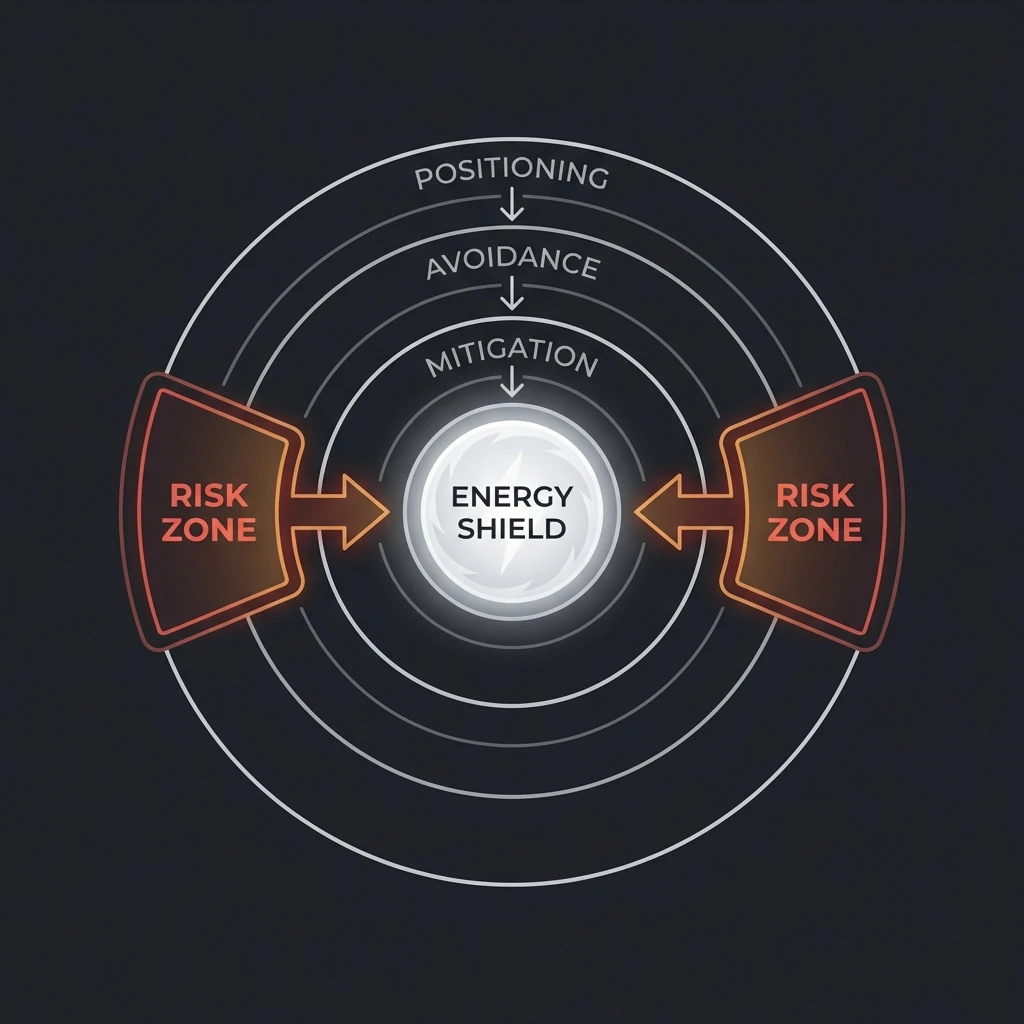
What players perceive as tankiness is actually the temporary success of several defensive layers operating in harmony:
- Energy Shield recharge uptime
- Damage mitigation layers
- Avoidance, evasion, and positioning
- Encounter pacing and pressure windows
As long as these layers remain synchronized, ES feels incredibly strong. The moment that synchronization breaks, survivability collapses.
In short: Energy Shield is not weak — it is conditional.
Energy Shield defensive layers and simultaneous failure
The defining weakness of ES-based defenses is not a lack of raw value, but a binary failure pattern.
Energy Shield relies on multiple systems that are either fully active or effectively offline:
- Recharge does not degrade gradually; it stops entirely
- Avoidance does not soften damage; it either succeeds or fails
- Mitigation gaps compound instead of averaging out
When several layers fail at the same time — due to burst damage, overlapping hits, or sustained pressure — there is no remaining buffer.
This creates what can be described as simultaneous defensive collapse:
- No gradual warning
- No meaningful recovery window
- No time to correct positioning
From the player’s perspective, this feels like transitioning from invulnerable to dead instantly.
Energy Shield vs Life builds: different failure curves
Comparing Energy Shield and Life builds highlights why ES deaths feel so jarring.
Life-based defenses tend to fail progressively:
- Damage reduces survivability in visible steps
- Recovery is slower but predictable
- Early mistakes are often survivable
Energy Shield defenses, by contrast, fail simultaneously:
- Multiple defensive assumptions break at once
- Recovery opportunities vanish instantly
- Feedback arrives only after the failure
This distinction is not about balance or power. It is about feedback timing.
Visual clutter, VFX density, and ES survivability
PoE2’s visual complexity significantly amplifies the Energy Shield failure problem.
High-density skill effects, bloom, overlapping animations, and enemy telegraphs compete for attention. For ES builds, this is especially dangerous because disengagement timing is critical.
When rising danger is visually obscured, players miss the opportunity to reposition or reset pressure — and Energy Shield offers no forgiveness once that window closes.
The result is a disconnect between player perception and the underlying simulation.
Why traditional PoE2 build analysis misses ES deaths
Most build evaluations focus on static indicators:
- Total Energy Shield
- Effective DPS
- Listed defensive layers
These metrics are useful, but insufficient.
They fail to describe dynamic failure: the specific combat states where defensive layers desynchronize and collapse together. A build can look excellent on paper and still be extremely fragile in real encounters.
Static stats describe potential. They do not describe risk.
Oracle analysis: identifying Energy Shield risk patterns
Energy Shield Risk AnalysisOracle Insights
Understanding failure patterns beyond surface stats
The Oracle evaluates survivability by focusing on how and when Energy Shield defenses fail rather than whether a build looks strong in isolation.
It analyzes patterns such as:
- Dependency on uninterrupted ES recharge
- Exposure to burst and overlap scenarios
- Margin for positional and reaction error
- Interaction between VFX density and defensive reliability
Instead of issuing absolute verdicts, the Oracle surfaces risk zones — situations where an Energy Shield build is statistically more likely to collapse without warning.
This reframes survivability from raw power to reliability under pressure.
Rethinking Energy Shield tankiness in Path of Exile 2
Energy Shield builds are not fragile.
They are unforgiving.
Once players understand how and why ES defenses fail, sudden deaths stop being mysterious. They become predictable — and therefore preventable.
True tankiness in PoE2 is not defined by how much damage a build can absorb when everything works.
It is defined by how much room for error remains when it doesn’t.
Want to understand how your build behaves under real failure conditions?
The Oracle analyzes Energy Shield survivability patterns beyond surface stats, highlighting where and why defensive layers are most likely to break down.