
Path of Codex is evolving with two major features in this initial phase: the Passive Tree Overview Phase 1 and the Oracle Journal.
Players can now clearly see their allocated passive points, the effects of socketed jewels, and record every strategic decision effortlessly.
Passive Tree Overview – Phase 1
What's new
- All allocated nodes, keystones, and tree stats are centralized in a single card.
- Stats are divided into Primary (core build identity) and Secondary (support/tactical stats).
- Jewels have their own cards, showing allocated passives, stat modifiers, and special effects.
- Fully auditable and extensible for future phases (Opportunity Cost, Efficiency Score).
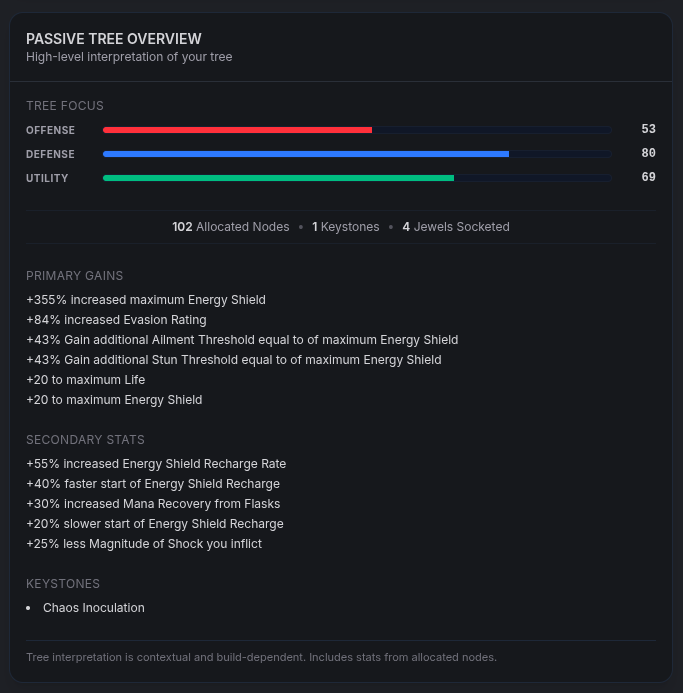
Note: At this phase, Opportunity Cost or Efficiency Score calculations are not included and there is no “good/bad” analysis or comparative ranking yet. The graphical tree visualization is also not implemented in this first release.
Oracle Journal – Strategic Log
The Oracle Journal records each snapshot of your build, including allocated passives and jewel effects, enabling you to:
- Save and compare builds over time.
- Record strategic decisions with notes.
- Tag entries for organization by build type or event.
- Automatically integrate with PoB Code import, ensuring that every build change or test is instantly reflected in your journal.

Usage example
“Testing Mental Alacrity + Storm Swell to increase crit chance on spell casts. Compared to previous builds, observed significant Spell Damage improvement.”
Conclusion
With the Passive Tree Overview Phase 1 and Oracle Journal, Path of Codex delivers clarity, organization, and control over every player decision, laying the foundation for advanced analyses and metrics in future phases.
This first phase establishes a solid base for Phase 2, which will include Opportunity Cost, Efficiency Score, and graphical visualization of the passive tree.