
Most build pages answer a simple question:
what are people playing?
It’s useful — but it doesn’t tell you what actually matters.
Because popularity is not the same as quality.
And frequency is not the same as strength.
That is why we built the Builds page differently.
Not just a list
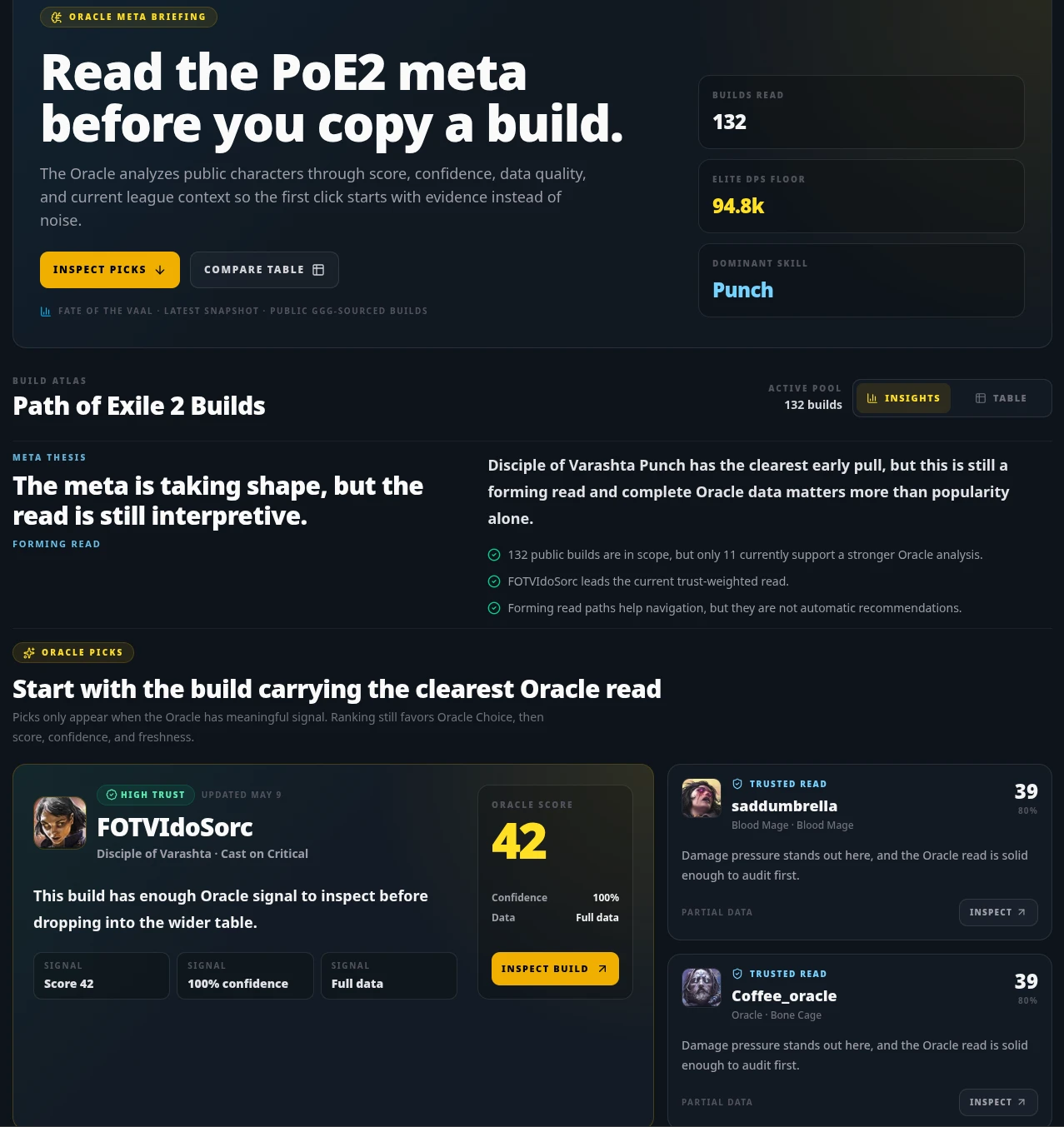
The Builds page is not a static list of characters.
It is a live view of the current build landscape — shaped not only by what players are using, but by how those builds actually perform.
Each build is analyzed through the same systems used across Path of Codex:
- Oracle Score — a structured reading of overall strength
- Verdict — what the build does well, where it struggles, and why
- Pillars — Damage, Survivability, Speed, and Optimization
- Context — level, progression stage, and real usage patterns
This means you are not just seeing builds.
You are seeing how they behave.
Beyond popularity
A build can be popular for many reasons:
- easy to start
- widely shared
- visually impressive
- mechanically simple
None of these guarantee that it performs well in the endgame.
The Builds page separates those signals.
Instead of asking “how many people are playing this?”, it helps answer:
- how strong is this build, really?
- where does it break down?
- what does it excel at?
- is it stable enough to invest in?
That difference matters.
Because in Path of Exile 2, a build that looks fine early can become a problem later — and by then, the cost of fixing it is much higher.
A build can clear maps comfortably and still collapse later due to scaling problems, survivability gaps, or inefficient progression paths.
Those weaknesses are often invisible in traditional build listings.
The goal of the Builds page is to surface those structural signals earlier.
Reading a build at a glance
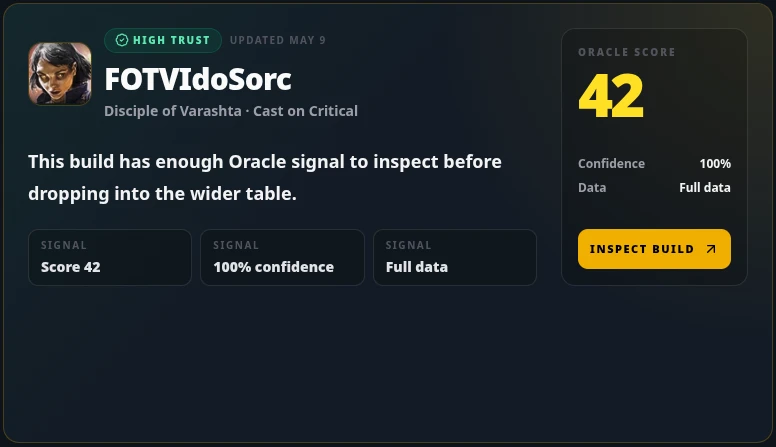
Each build card is designed to be readable in seconds.
You can immediately see:
- Score and Tier — a quick classification of overall strength
- Verdict — a short, contextual summary
- Core strengths — where the build performs best
- Weak points — where it may struggle
- Progression signals — indicators tied to scaling and late-game stability
- Class and Ascendancy context — how the build fits within the current landscape
The goal is not to overwhelm players with raw data.
It is to compress complex analysis into signals that are understandable at a glance.
Built for comparison, not just browsing
The purpose of the Builds page is not only discovery.
It is decision-making.
Whether you are:
- looking for a stable league starter
- comparing ascendancies
- researching endgame progression
- evaluating survivability trade-offs
- studying optimization paths
- or simply trying to understand why one build succeeds while another struggles
…the system is designed to provide structured context instead of isolated statistics.
Because the most important question is rarely:
"What are people playing?"
It is:
"Why does this build actually work?"
A living view of the meta
The Path of Exile 2 meta changes constantly.
Balance updates, passive tree shifts, item discoveries, and evolving optimization strategies can rapidly alter how builds perform.
The Builds page is designed to evolve alongside that ecosystem.
Not as a static ranking.
But as a continuously updated interpretation layer built around real character data and structural analysis.
The goal is simple:
to help players understand builds — not just copy them.