
One of the most common situations in Path of Exile 2:
you've been playing your character for weeks. It works. — but then you find a build online that looks stronger.
Or maybe you're just starting out and can't decide which class to commit to.
Either way, the question is always the same:
"Is this actually worth it?"
The Compare page was built to answer that question directly — and it plays a central role in the Path of Codex Season 0.5 update.
The problem with comparing builds manually
Most build comparisons in PoE2 happen through isolated numbers.
One build has more DPS. Another has more life. Another clears maps faster.
But those numbers rarely explain the real cost of the change. A build with massive damage might collapse defensively. A tankier setup might completely kill your progression speed. A Passive Tree that looks efficient on the surface may hide structural weaknesses that only become visible later.
The problem is not seeing the numbers. The problem is understanding the trade-offs behind them.
That is exactly what Compare was designed to solve.
How it works
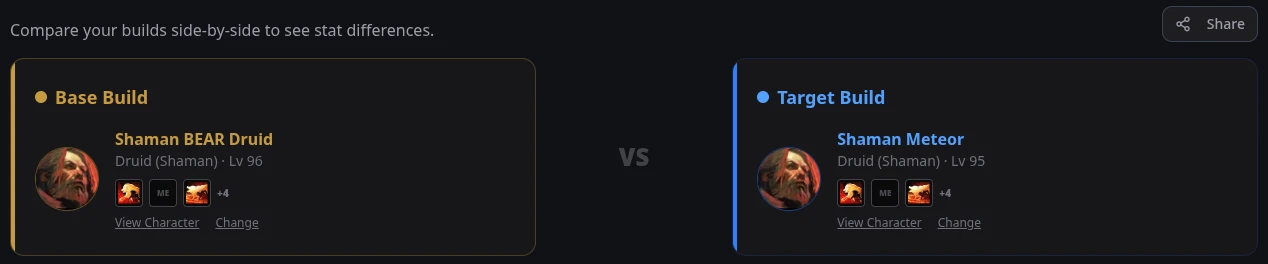
The Compare page has two slots: a Base Build and a Target Build. Both can be any character imported from your GGG account or any saved build from your profile.
Once both slots are filled, the Oracle runs a full analysis of each build and generates a side-by-side breakdown of offense, defense, attributes, resistances, survivability, progression signals, and structural differences.
Color-coded deltas immediately show what changes between the two builds. But more importantly, you understand what they mean — through the same systems that power the Build Oracle Score and the Oracle Verdict.
Benchmark Mode
Benchmark Mode activates automatically when the two builds belong to different ascendancies.
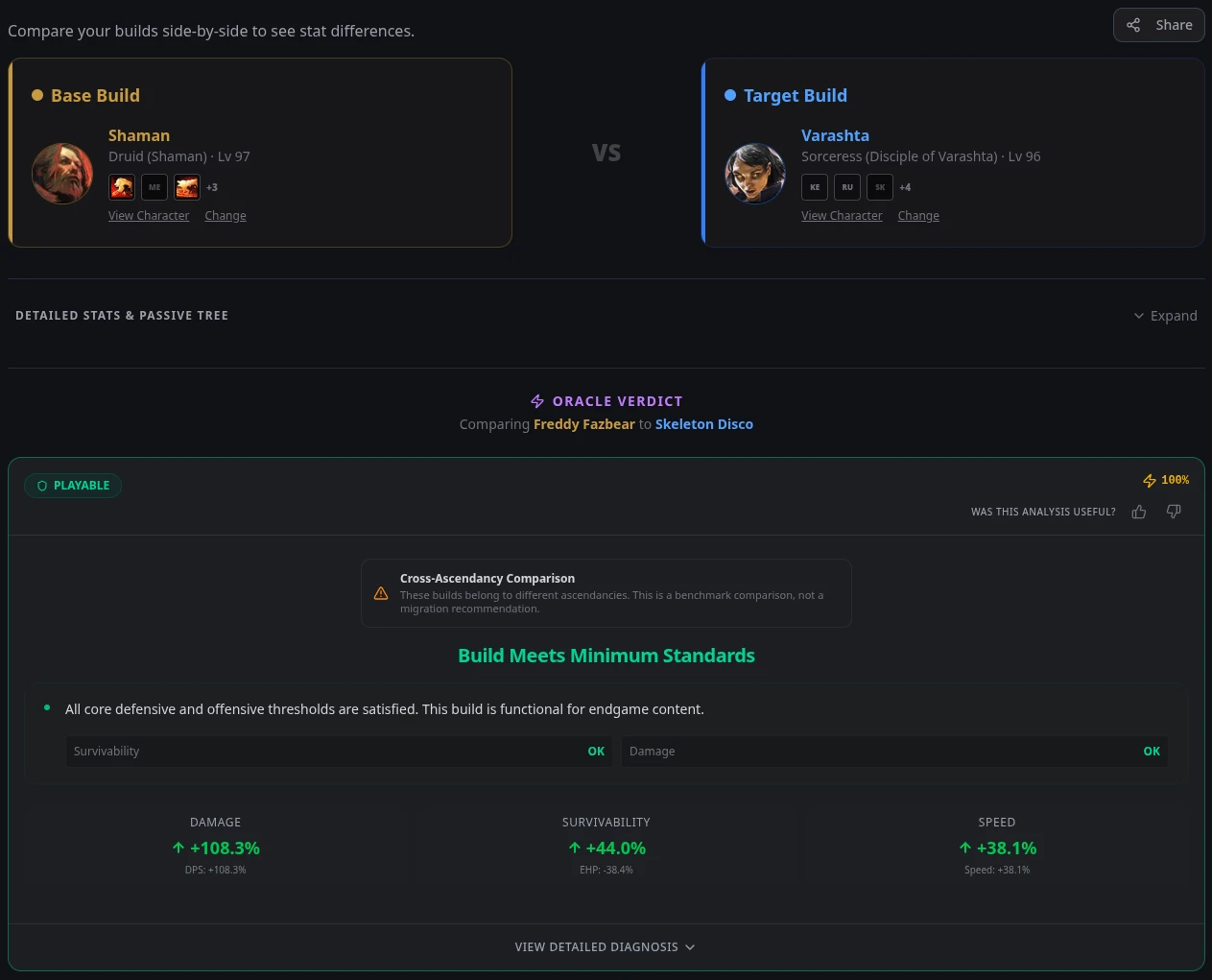
Not every comparison is a migration.
This is the "What should I play?" scenario.
Since this is not a direct migration path, the Oracle treats the comparison as a broader reference analysis. The goal is not to tell you which build is objectively superior — it is to reveal viability, trade-offs, hidden weaknesses, progression risks, and build identity differences before you commit to a character.
This becomes especially valuable early in a league, when a wrong decision can cost dozens of hours later.
Migration Mode
Migration Mode activates automatically when both builds share the same ascendancy.
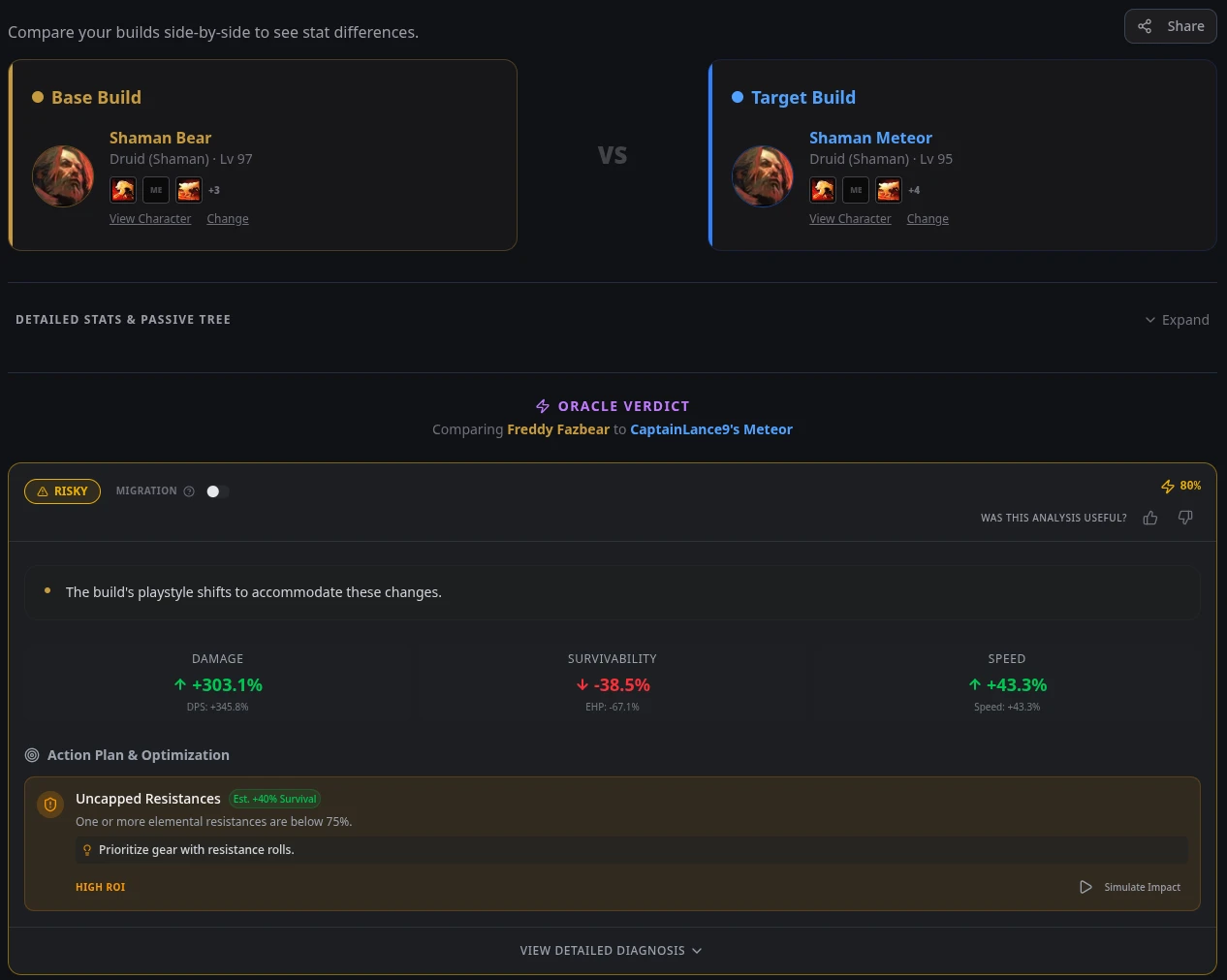
This is the "Should I switch?" scenario.
You already have a character invested into the game, and now the Oracle evaluates whether moving to another build is an upgrade, a sidegrade, or a dangerous trade-off.
In the example above, the verdict is RISKY. The numbers explain why:
- Damage: +345.9%
- Survivability: −70.6%
- Speed: −15.1%
At first glance, the damage gain looks incredible. But the Oracle understands that damage alone does not define a healthy build. Once survivability, scaling behavior, and progression impact are considered together, the trade-off becomes much more dangerous than the DPS increase initially suggests.
This is where Compare stops being a stat screen — and becomes a decision system.
Oracle Insights
Below the Verdict, Oracle Insights breaks the comparison into focused dimensions.
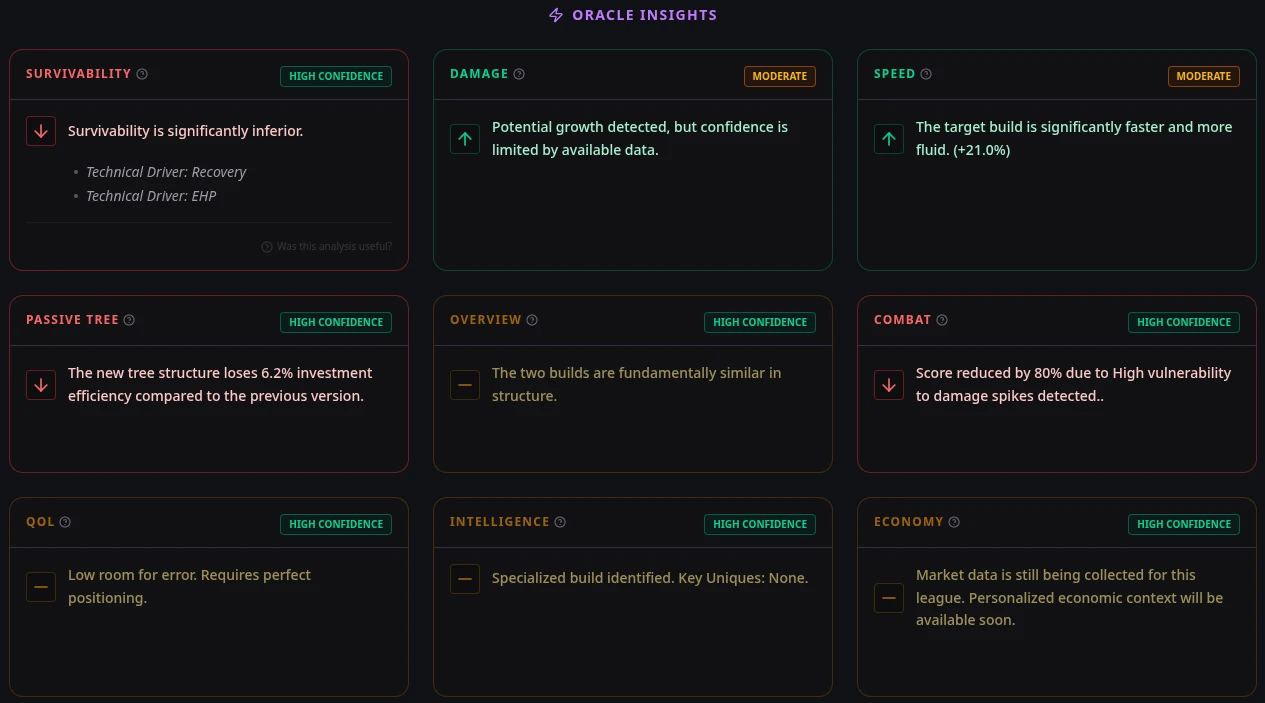
Each card isolates a specific aspect of the builds: survivability, damage behavior, speed, Passive Tree efficiency, combat profile, and optimization quality. Instead of forcing you to manually interpret dozens of numbers, the Oracle translates those systems into readable conclusions with confidence ratings.
In Passive Tree analysis, for example, the system can detect inefficient investment distribution, weak defensive pathing, scaling bottlenecks, or poor synergy between mechanics.
Confidence matters
Every comparison includes a confidence rating: High, Moderate, or Low.
This rating reflects how complete and reliable the available data is. When confidence is lower, the Oracle says so explicitly — it does not pretend certainty.
This is especially important in PoE2, where incomplete imports, hidden variables, or missing data can dramatically distort a comparison. The Oracle would rather surface uncertainty than give misleading confidence.
Why this matters
Compare is not just about choosing between two builds. It is about understanding the cost of your decisions before you pay for them.
A build that looks stronger on paper may create hidden weaknesses that only become visible after major investment. The Oracle helps surface those risks early.
And once a migration or major change happens, the system continues tracking its consequences through the Timeline, the Notification Center, and future Oracle Verdicts as your character evolves.
This article is part of the Path of Codex Season 0.5 update.
→ Full Season 0.5 overview
→ Build Oracle Score
→ Oracle Journal & Verdict
→ Build Compare
→ Timeline
→ Passive Tree & Build Identity