
Building a character in Path of Exile 2 is not just about choosing the right skills, items, or Passive Tree nodes.
As your character progresses, your build changes.
You replace gear. You adjust passives. Your defensive layers evolve. Your damage scaling changes. A temporary leveling setup becomes an endgame build. Decisions that made sense several hours ago may no longer make sense now.
That creates a problem that a simple build snapshot cannot solve:
How do you understand the evolution of your PoE2 build, rather than just looking at its current stats?
This is where the Path of Codex Oracle comes in.
The Oracle is a contextual PoE2 build analysis system designed to develop an understanding of your character over time.
It is built around three connected concepts:
Oracle Journal.
Oracle Verdict.
Oracle Memory.
Each serves a different purpose — recording what happened, interpreting what it means, and preserving the context needed to understand the character as it evolves.
What is the Path of Codex Oracle?
The Oracle is Path of Codex's approach to Path of Exile 2 build analysis.
A conventional PoE2 build analyzer can show you the current state of your character: equipment, skills, passives, defenses, and other statistics.
That information is useful, but it is still a snapshot.
The Oracle focuses on the layer beyond the snapshot:
What does the current state mean?
And just as importantly:
How does that understanding change as the character progresses?
A character is not static.
Its current build is the result of previous decisions, upgrades, passive changes, and progression stages. The Oracle is designed to preserve that context so that build analysis can become a continuous process rather than a collection of disconnected evaluations.
That is the foundation of the Oracle experience.
Oracle Journal: Your PoE2 Build Analysis History
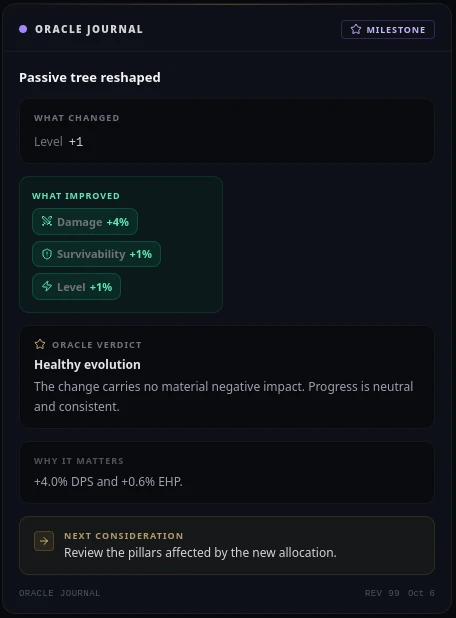
The Oracle Journal is the historical record of your character's analysis.
Instead of treating every PoE2 build analysis as an isolated event, the Journal creates a chronological record of meaningful observations about the character.
When the Oracle identifies something relevant about the build, that knowledge can become part of the character's analytical history.
This might involve a meaningful change in equipment, passive allocation, build direction, or another development that changes how the character should be understood.
The Journal is therefore more than an activity log.
It is a readable history of the Oracle's understanding of the build.
Over time, that history answers questions that a conventional PoE2 build calculator or build checker cannot easily answer:
- What did the Oracle identify earlier in the character's progression?
- What changed after a major upgrade?
- How did the build's direction evolve?
- What conclusions were reached at different points in the character's development?
The result is a persistent record of PoE2 build progression.
The Journal records the knowledge.
Oracle Verdict: Understanding Your PoE2 Build
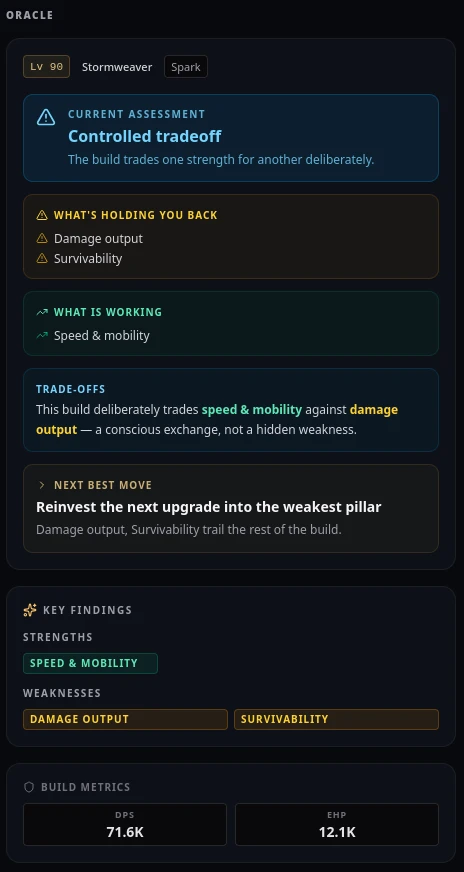
The Oracle Verdict is where analysis becomes a conclusion.
A Path of Exile 2 character contains thousands of interconnected details.
Your level matters.
Your ascendancy matters.
Your equipment matters.
Your Passive Tree matters.
Your skills, defensive layers, scaling, and progression context all matter.
But looking at those elements individually does not necessarily tell you what they mean together.
That is the role of the Verdict.
The Oracle Verdict provides a contextual reading of the character based on the evidence available for that build.
Instead of asking only:
"What are my stats?"
the Verdict addresses the more useful question:
"What does the current state of my build actually mean?"
This distinction is particularly important in PoE2 because a character can appear strong in one area while carrying a structural weakness somewhere else.
Likewise, a character that does not look highly optimized may still be progressing appropriately for its current stage.
The Verdict is designed to interpret those relationships rather than reduce the character to a single number.
The Verdict represents the conclusion.
Oracle Memory: Persistent Context for Your PoE2 Character
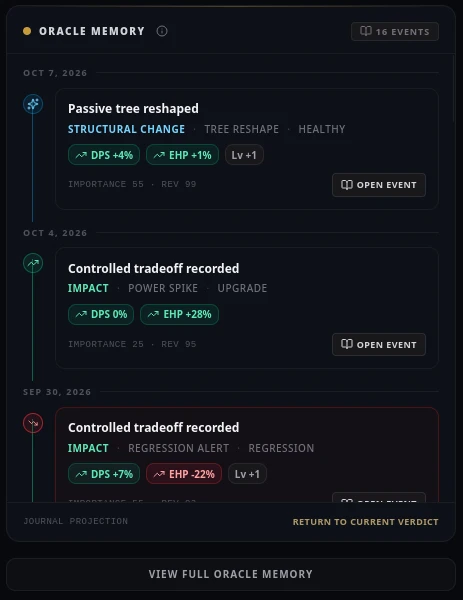
The third part of the Oracle is Oracle Memory.
Memory solves a fundamental problem with repeated PoE2 build analysis:
A character changes, but the context behind those changes should not disappear.
Without persistent context, every analysis effectively starts from the current snapshot.
That means the system can see what your character looks like now, but has less understanding of how it arrived there.
Oracle Memory is designed to preserve relevant historical context around the character and its build.
This allows future analysis to build upon previously established knowledge instead of treating every new character state as completely unrelated to the previous one.
Memory is not simply about storing everything.
Its purpose is to preserve the context that is meaningful to understanding the build.
A major upgrade, a change in build direction, or another significant development can matter differently when viewed in the context of what came before.
Memory preserves the context.
How Oracle Journal, Verdict and Memory work together
The easiest way to understand the current Oracle architecture is:
Journal records.
Verdict concludes.
Memory remembers.
Consider a PoE2 character that receives a significant gear upgrade.
The Oracle analyzes the new character state.
The Verdict determines what that change means for the build.
The relevant observation can become part of the Journal, creating a historical record of the analysis.
Oracle Memory preserves the context that matters for understanding the character beyond that individual snapshot.
Later, another item is replaced or the Passive Tree changes.
The Oracle is no longer looking at an isolated build.
It has accumulated context.
It has previous observations.
It has previous conclusions.
That is what allows the analysis to become continuous.
Why a PoE2 build analyzer needs context
Most build tools are excellent at answering questions about the present.
What is my damage?
How much survivability do I have?
What items am I wearing?
Which Passive Tree nodes am I using?
What skills are equipped?
Those questions are important.
But build progression creates another category of questions:
Why does this build look different from before?
Was this change an improvement?
What did the Oracle identify previously?
Is the character moving in the right direction?
What should be understood in the context of the decisions already made?
These are historical and contextual questions.
A simple snapshot cannot answer them by itself.
That is why the Oracle is built around Journal, Verdict, and Memory rather than around a single build score.
PoE2 Build Analysis Is More Than a Score
A single score can be useful as a quick signal.
But a number cannot fully explain a character.
Two Path of Exile 2 characters can have similar headline statistics while having completely different strengths, weaknesses, progression paths, and structural problems.
Likewise, a build that is appropriate for one stage of progression may be inappropriate for another.
Context matters.
The Oracle therefore focuses on understanding the build, not simply assigning it a number.
The goal is not to replace detailed PoE2 build tools.
The goal is to add a layer of contextual intelligence around them.
From PoE2 Build Snapshot to Build History
A traditional PoE2 build analyzer answers:
"What does my character look like right now?"
The Oracle adds another dimension:
"What does the Oracle know about this character, and how has that understanding developed?"
That difference becomes increasingly valuable as a character becomes more complex.
Early in progression, a build can change rapidly.
Later, upgrades become more deliberate.
Passive decisions become more expensive.
Gear choices become more specialized.
The further a character progresses, the more useful historical context becomes.
The Oracle is designed around that progression.
Your character does not have to start from scratch every time you return to analyze it.
Why the Oracle matters for PoE2 endgame builds
The endgame is where build decisions become increasingly consequential.
A character may technically function while still having weaknesses that limit its next stage of progression.
You may be deciding whether to invest in a new item.
You may have changed your Passive Tree.
You may be transitioning toward a different version of the same archetype.
Or you may simply want to understand whether the build is developing in a healthy direction.
This is where contextual PoE2 character analysis becomes particularly useful.
The Oracle does not remove the complexity of Path of Exile 2.
It gives that complexity a persistent analytical context.
The three layers of the Oracle
The current Oracle experience can be summarized simply:
Oracle Journal
What has the Oracle recorded?
The Journal provides the chronological history of meaningful observations and analysis.
Oracle Verdict
What does the Oracle conclude?
The Verdict interprets the available evidence and provides a contextual understanding of the character.
Oracle Memory
What does the Oracle remember?
Memory preserves relevant context so future analysis can build on the character's history.
Together:
Journal records the knowledge.
Verdict represents the conclusions.
Memory preserves the context.
That is the foundation of the modern Oracle experience at Path of Codex.
A different way to analyze a PoE2 build
Path of Exile 2 gives players enormous freedom to create and evolve characters.
That freedom also creates complexity.
The more a character changes, the harder it becomes to understand its complete history through a single snapshot.
The Oracle is designed to bridge that gap.
It does not simply ask whether a build is good or bad.
It asks what the evidence means, what has been learned about the character, and how that understanding fits into the character's progression.
For players looking for a PoE2 build analyzer, that is the distinction that matters.
You are not just looking at a build.
You are building a history of understanding around it.
Journal. Verdict. Memory.
The Oracle turns those three ideas into a continuous layer of Path of Exile 2 build analysis inside Path of Codex.
This article is part of the Path of Codex Season 0.5 update.