
Passive Trees Should Explain Builds — Not Just List Nodes
Have you ever opened a character's Passive Tree on some site and found yourself staring at a massive list of numbers with no idea what actually matters?
That is exactly the problem that motivated us to think differently.
Path of Exile 2 builds are too complex to be understood through raw node listings alone.
So instead of asking players to manually interpret hundreds of passive nodes, Path of Codex extracts the structural identity behind the build.
The traditional approach
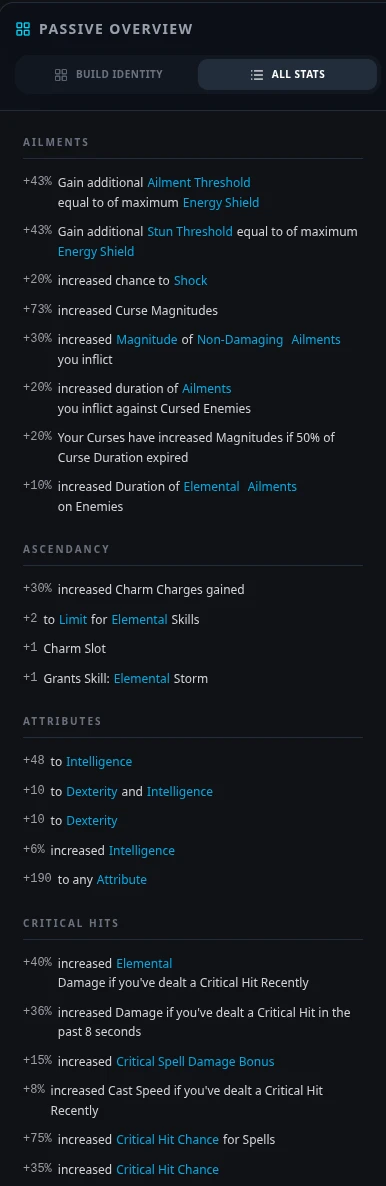
Most sites display the Passive Tree the same way: a full listing of every allocated node.
It is useful. But it is exhausting.
If you want to understand how a build actually works, a list of 149 nodes will not tell you.
It gives you the ingredients without explaining the recipe.
Our approach — Build Identity
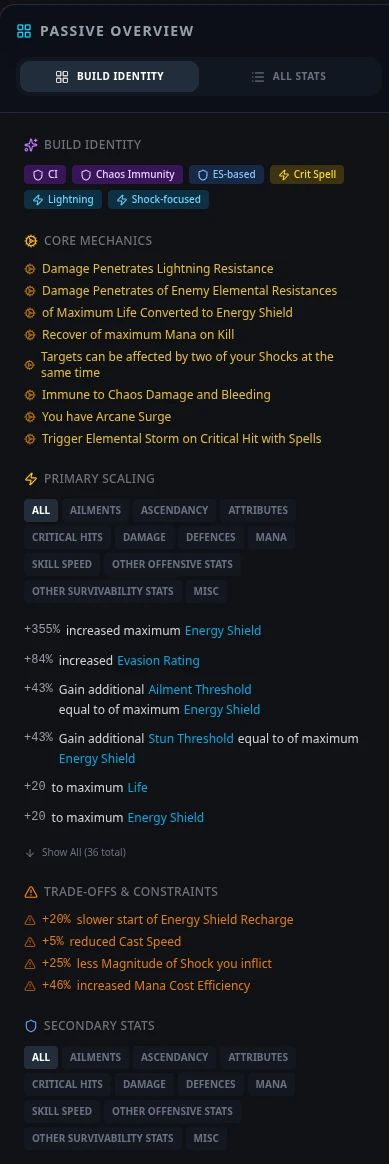
The default view in Path of Codex is Build Identity.
Instead of listing everything equally, it extracts the essence of a character in layers — each one answering a different question.
And more importantly: it connects directly to how your build is evaluated across the rest of the platform — from your Oracle Score to the conclusions surfaced in the Oracle Verdict.
Let us use a real example: Ocaduzeira, Stormweaver level 94.
Tags
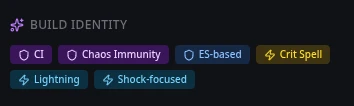
CI · ES-based · Crit Spell · Shock-focused
Four words.
That is enough to immediately understand the character's foundation.
Not every allocated node matters equally. Build Identity focuses on the ones that define how the build fundamentally functions.
This identity is not just descriptive — it also shapes how the character is interpreted across the platform, including comparisons inside Build Compare.
Core Mechanics
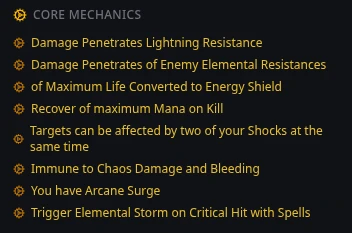
These define how the build actually works.
For Ocaduzeira:
- Damage Penetrates Elemental Resistances
- Maximum Life converted to Energy Shield
- Recover Mana on Kill
- Targets can be affected by two Shocks
- Immune to Chaos Damage and Bleeding
- Trigger Elemental Storm on Critical Hit
These are not bonuses.
They are structure.
They are also the foundation the Oracle uses to determine whether a build is coherent, specialized, or fragmented.
Trade-offs & Constraints
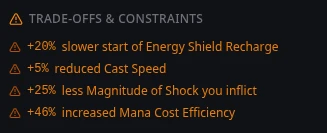
This is where many builds quietly break.
Every decision has a cost:
- Reduced Cast Speed
- Less Shock Magnitude
- Slower Energy Shield Recharge
These trade-offs often explain why a build feels weaker than expected — even when the visible numbers look strong.
This is exactly the type of issue that later surfaces inside the Oracle Verdict or affects your final Oracle Score, especially within Survivability and Optimization.
Primary Scaling vs Secondary Stats
Build Identity separates what truly defines the build from what simply supports it.
Primary Scaling
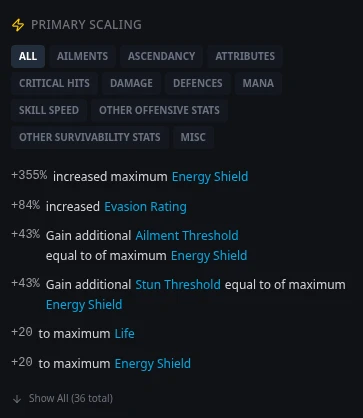
What the build fundamentally depends on.
Secondary Stats
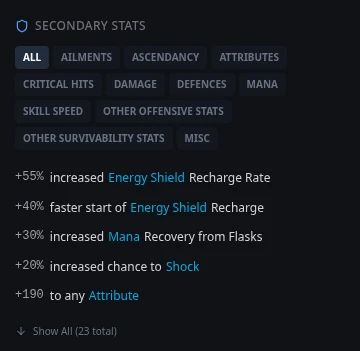
What improves the build without defining it.
This distinction answers one of the most important optimization questions in Path of Exile 2:
"If I need to change something, what can I remove without breaking the build?"
This becomes even more important when comparing builds side by side in Build Compare, where small structural differences can lead to very different outcomes.
All Stats is still there
The complete node listing still exists.
The difference is that now it is optional — not your only way of understanding the tree.
You can still inspect every passive node individually whenever you want.
But the platform no longer assumes that raw information alone is enough to explain a build.
A living structure
Your Passive Tree is not static.
As you respec nodes, test variations, or adapt your character, its identity evolves.
Those changes are reflected over time in your Timeline, giving you a clear view of how your build develops across progression.
And when a structural change introduces a critical issue — or significantly alters your performance — the system surfaces it immediately through the Notification Center.
Because understanding a build should not depend on manually reading hundreds of disconnected nodes.
Why this matters
Path of Exile 2 has one of the most complex Passive Tree systems ever created.
That complexity is part of what makes the game great.
But complexity without interpretation creates friction.
Our goal with Build Identity is not to reduce depth.
It is to make depth readable.
So instead of asking players to decode massive lists of passives manually, Path of Codex helps reveal the structure behind the build — the mechanics, trade-offs, scaling, and decisions that actually define how the character works.
Because a Passive Tree should explain the build.
Not just list the nodes.
This article is part of the Path of Codex Season 0.5 update.
→ Full Season 0.5 overview
→ Build Oracle Score
→ Oracle Journal & Verdict
→ Build Compare
→ Timeline
→ Passive Tree & Build Identity